
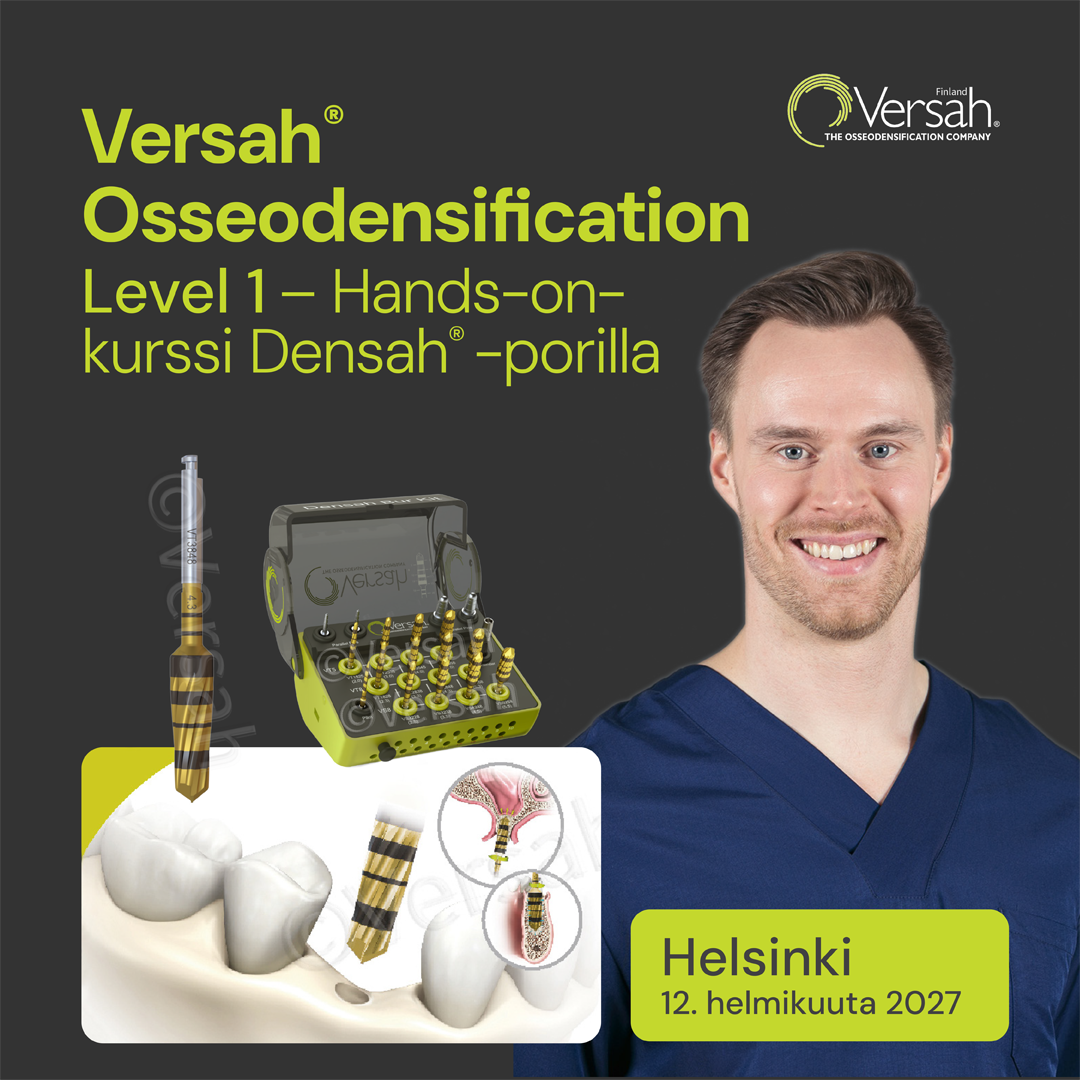
Versah® Osseodensification Level I
Finland’s first Versah® Densah® course
Register now →
Places are limited to 18 participants.
Date: Friday 12 February 2027
Time: 09:00–17:00
Venue: VALO Hotel & Work, Mannerheimintie 109, 00280 Helsinki, Finland
Fee: 790€ (incl. VAT), lunch and coffee included
Participants: Max. 18
Registration deadline: 8 January 2027
Language: Finnish
About the course
The aim is to reduce tissue trauma and create a better foundation for durable, aesthetic implant treatment.
The course covers the principles of osseodensification, the research behind it and how it is used in implant surgery. With this approach, the osteotomy is prepared by compacting bone with Versah® Densah® Burs. We look at how bone-preserving preparation, and choosing the right technique for each patient, support tissue health and the long-term function and aesthetics of implant treatment.
The course is built on the SPAcademy philosophy: “Nothing is accidental.” Through research, patient cases and hands-on sessions, we look at how osseodensification can improve treatment prognosis and reduce the trauma caused by treatment. We also cover when the method is likely to help and where its limits are.
“Never settle” means continuous learning and critically assessing your own work. You need to understand what benefits the patient, why a method works and when using it is justified.
The first hands-on session starts before lunch, so you can apply the fundamentals early in the day. In the afternoon we move on to further clinical applications. The course is capped at 18 participants so everyone gets time for personal guidance, discussion and feedback.
Clinical perspective
“To me, the most important job of implant surgery is to build a reliable foundation for the future prosthetic restoration: sufficient, healthy hard and soft tissue. Treatment planning has to look decades ahead. The goal is tissue that supports the long-term function and aesthetics of the restoration. When treatment is based on biologically sustainable solutions, durability and aesthetics are more likely to follow.
In my own work, osseodensification has proven useful across several surgical techniques. It has helped me make procedures less invasive, reduce tissue trauma and shorten treatment time. On this course, we combine research evidence, clinical reasoning and surgical technique. The goal is to help you use osseodensification in your daily work and bring what you learn into the care of your patients.”
— Ilkka Pallonen
Learning objectives
By the end of the course, participants will be able to:
Explain the scientific basis of osseodensification and critically evaluate treatment outcomes and research evidence.
Describe how Densah® Burs work, and how they are used to prepare the osteotomy, preserve bone and expand the alveolar ridge in a controlled way.
Select the right preparation protocol using the Versah® drilling guidelines, and explain the role of the Densify After Cut (DAC) protocol. Protocol choice takes into account bone quality, local anatomy, implant system and indication.
Describe the indications, limitations and steps of key techniques: crestal sinus floor elevation with autografting, lateral ridge expansion, immediate implant placement and molar septum expansion.
Perform core osseodensification techniques on bone specimens and simulation models. Hands-on sessions cover osteotomy preparation, lateral ridge expansion and transcrestal sinus floor elevation.
Explain how osseodensification relates to implant stability and assess its role when planning early or immediate loading.
Identify patient- and site-related risks, and situations where a different treatment approach is needed. Participants will also be able to describe how complications are prevented and managed.
Use osseodensification in prosthetically driven treatment planning, taking into account hard and soft tissue needs, long-term tissue health, function and durability of the restoration, aesthetics, and the invasiveness and tissue trauma of each procedure.
Course programme (PDF): Suomeksi | In English
Programme
09:00–10:00 | Nothing is accidental: biology, evidence and treatment planning
The fundamentals of osseodensification and the compaction autografting mechanism, along with key biomechanical, histological and clinical studies. We look at how the planned prosthetic restoration and its supporting tissues guide site preparation.
10:00–10:15 | Coffee break
10:15–11:00 | Clinical protocols I: fundamentals and osteotomy preparation
The design and working principles of Densah® Burs, and how to choose the drilling sequence based on bone quality and implant system. We cover implant system-specific drilling guidelines and the Densify After Cut (DAC) protocol, and prepare for the hands-on session.
11:00–12:00 | Hands-on I: core technique and osteotomy preparation
Working on bone specimens and simulation models, with a focus on instrument handling, reading bone feel and drilling sequence.
12:00–12:45 | Lunch
12:45–14:00 | Clinical protocols II: applications of the method
Lateral ridge expansion, immediate implant placement and molar septum expansion, plus transcrestal sinus floor elevation with autografting. Through patient cases, we cover indications, anatomical requirements, clinical steps, limitations and complication prevention for each technique.
14:00–15:15 | Hands-on II: lateral ridge expansion
Controlled ridge expansion and osteotomy preparation. We select and apply protocols in simulated patient scenarios.
15:15–15:30 | Coffee break
15:30–16:30 | Hands-on III: transcrestal sinus floor elevation
A transcrestal sinus lift on a model, following the clinical protocol. The focus is on instrument control, clinical steps and recognising the limits of the technique. We go through how to solve problem situations, and each participant’s technique is reviewed individually.
16:30–17:00 | Summary and Q&A
We bring together the day’s key lessons: patient selection, protocol selection, tissue preservation, and complication prevention and management. We look at implant stability in relation to loading decisions, then close with questions and a discussion of how to apply what you’ve learned in clinical practice.
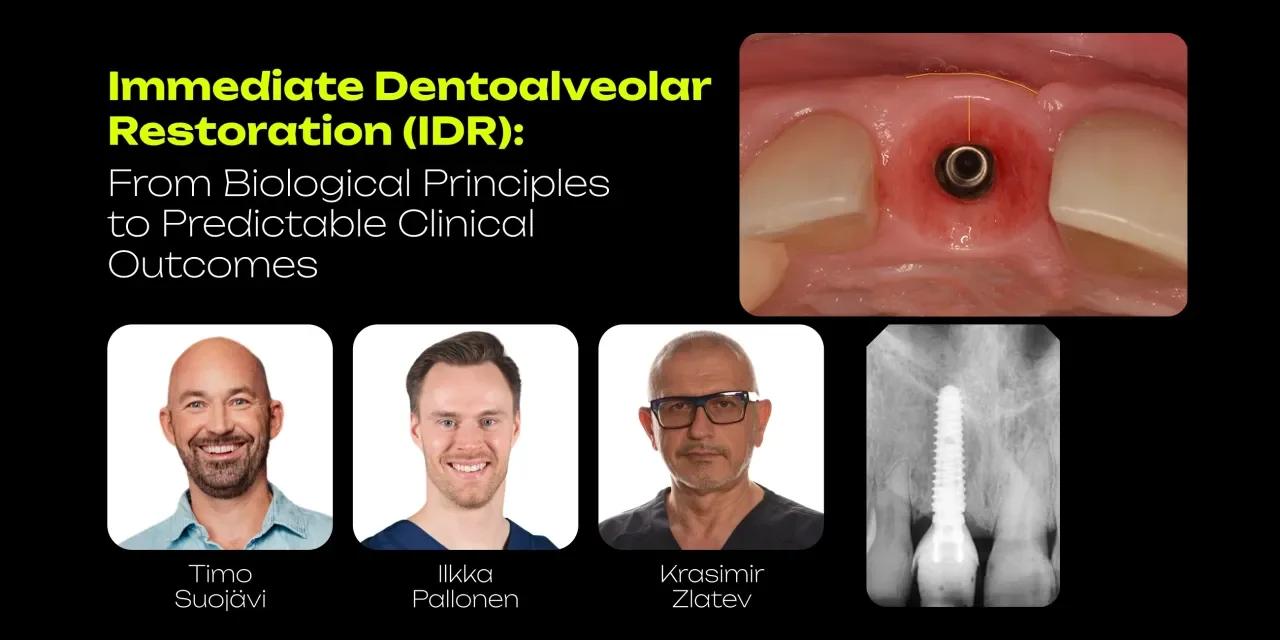

Available On-Demand via ITI Academy. Precise timing in implant dentistry is critical to optimizing clinical outcomes, preserving tissue health, and enhancing patient satisfaction.